
“I’m quite naturally drawn to the random stuff that we just do, but we don’t really notice we’re doing it,” says artist Isabella Loudon. “It’s the marks that we get while we’re not trying to make them, but we’re trying to achieve something else. And those things are impossible to create when you’re trying to create them.” Loudon’s show – Everything Might Spill – is on at Te Whare o Rehua Sarjeant Gallery in Whanganui until October. You really should go and see it. It’s the first site-specific installation in the heritage part of the gallery, which reopened as part of the expanded and restored building last year after a six-year refurbishment.
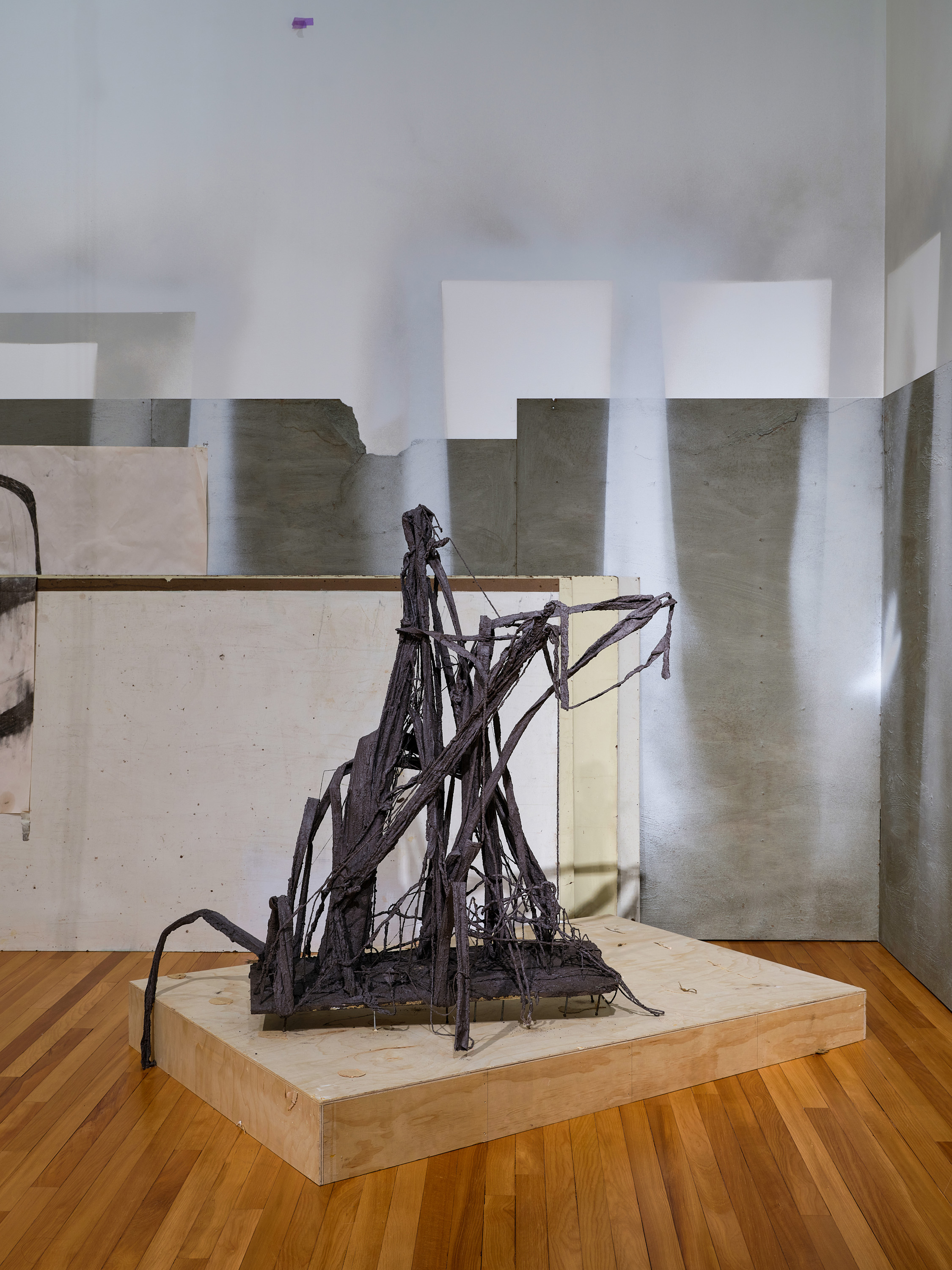
You might know Loudon: we featured the artist in the third issue of Here back in 2020. At that time, she was working mostly with rope and concrete, literally rubbing cement into rope, then hanging it over hooks and allowing the material to dry in big loops. The effect is obscure and intriguing. There’s a dissonance to her work, in which naturally soft things are somehow frozen in a moment. They’re solid but they have a sense of captured movement. “I like using gravity as a way to shape the work,” she says.
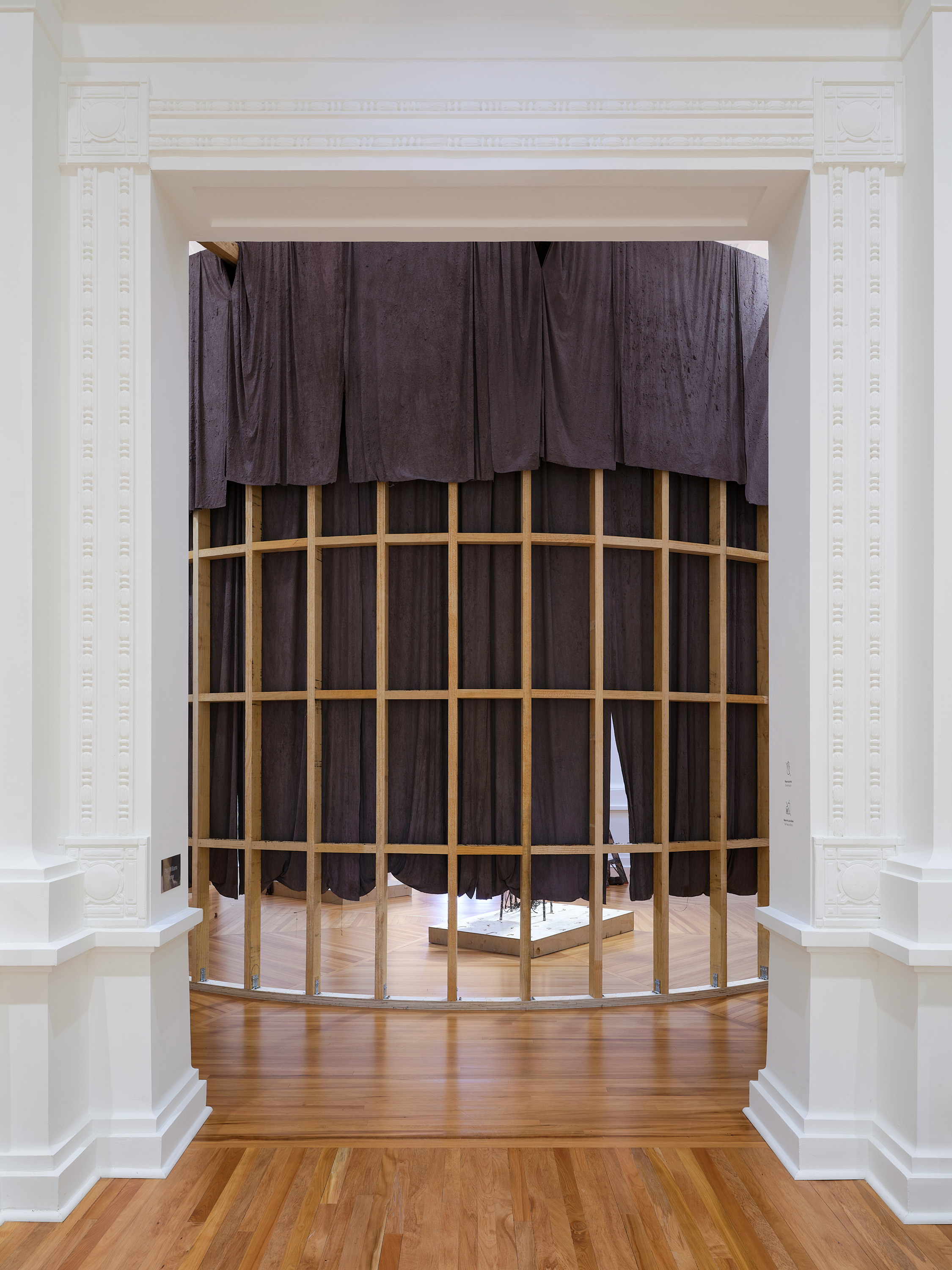
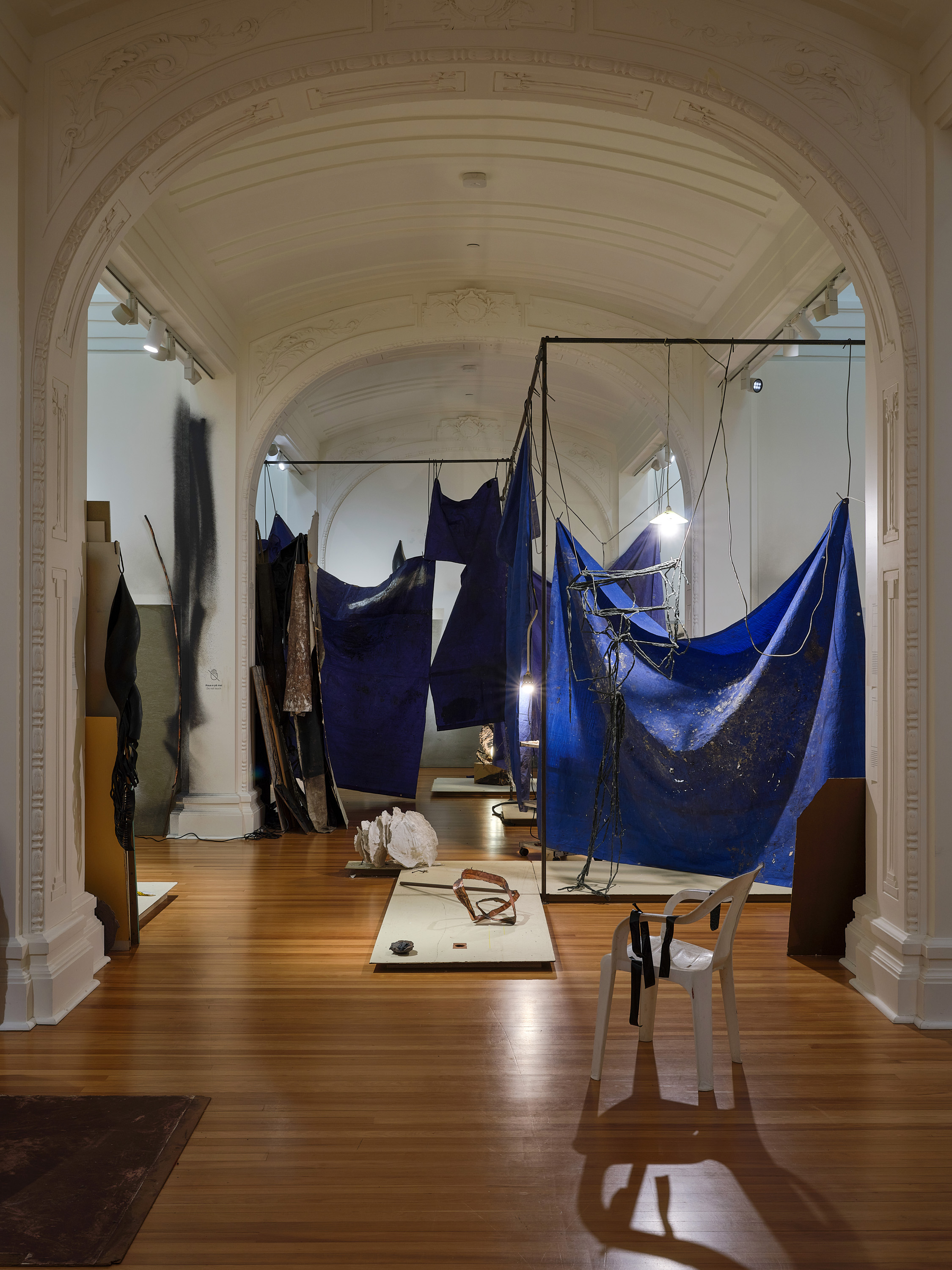
At the centre of the show, right below that historic dome so carefully restored, sits The Performance. Facing the original front door, its back is turned on the entry to the new extension. It’s an act of refusal – though Loudon typically arrived at it instinctively. “I spent a lot of time in the space, thinking, watching people, seeing how they came in and engaged with the architecture. I was really interested in the fact that it was such a ‘through space’ to other galleries. They really just looked up at the architecture, and then walked through to somewhere else. So I really wanted to disrupt that.”
The Performance is a timber frame, over which is draped a curtain made from fabric that has been soaked and solidified with concrete. It sits a metre above the ground, in the act of being raised, yet somehow frozen in time, shaped in a semi-circle with other works sitting poised within a room. It’s a continuation of her fascination with the marriage between textile and concrete. “The fabric wouldn’t hold if it didn’t have the concrete, and the concrete would never hold that shape without the fabric, so there’s a symbiotic relationship between the two,” she says. “In my works, there’s often just two materials involved, and that’s the relationship between them. They rely on each other.”
She spent three weeks installing the show at the Sarjeant Gallery, using a mixture of new and old works, disassembling and reconstituting as she went: she’s not precious about things, and often breaks work down to repurpose it elsewhere. “Things are probably going to get broken, and that’s totally fine – that’s the work continuing to evolve,” she says. “Some of the pieces are actually in a state of being broken, and that was the intention. I knew that what I was doing was beyond the limits of the material. I don’t treat anything as precious. It’s an evolution, it’s living as a cycle.”
It’s a process of deliberate unthinking. “It takes me quite a while to get to that space,” she says. “You’re not trying to think of something: you knock something over, or you move that there, or you just do that, and then you see it in a different way. Or you’re trying to try something out – so I need to figure out a way to do it.”
Here, she initially found herself thinking too much. “I found myself staging for about four days, thinking really hard about how people would engage with it.” Eventually, Sarjeant senior curator Greg Donson came in to look at the progress. “I just don’t think it’s Isabella enough,” he said gently. Loudon: “So then I just started doing. I hung that there, and moved that there, and took that nail out. I started treating it like a studio.”
Partly, it was the reverence of the building that held her back. “I remember thinking, ‘I can’t deal with this building, this building hates me. I can’t hang anything, I can’t do anything, the floor is precious,’” she says. To anchor The Performance, they had to carefully drill into the masonry walls of the dome. “The first one felt terrible,” she admits. “And then I just thought, ‘Oh it’s fine.”
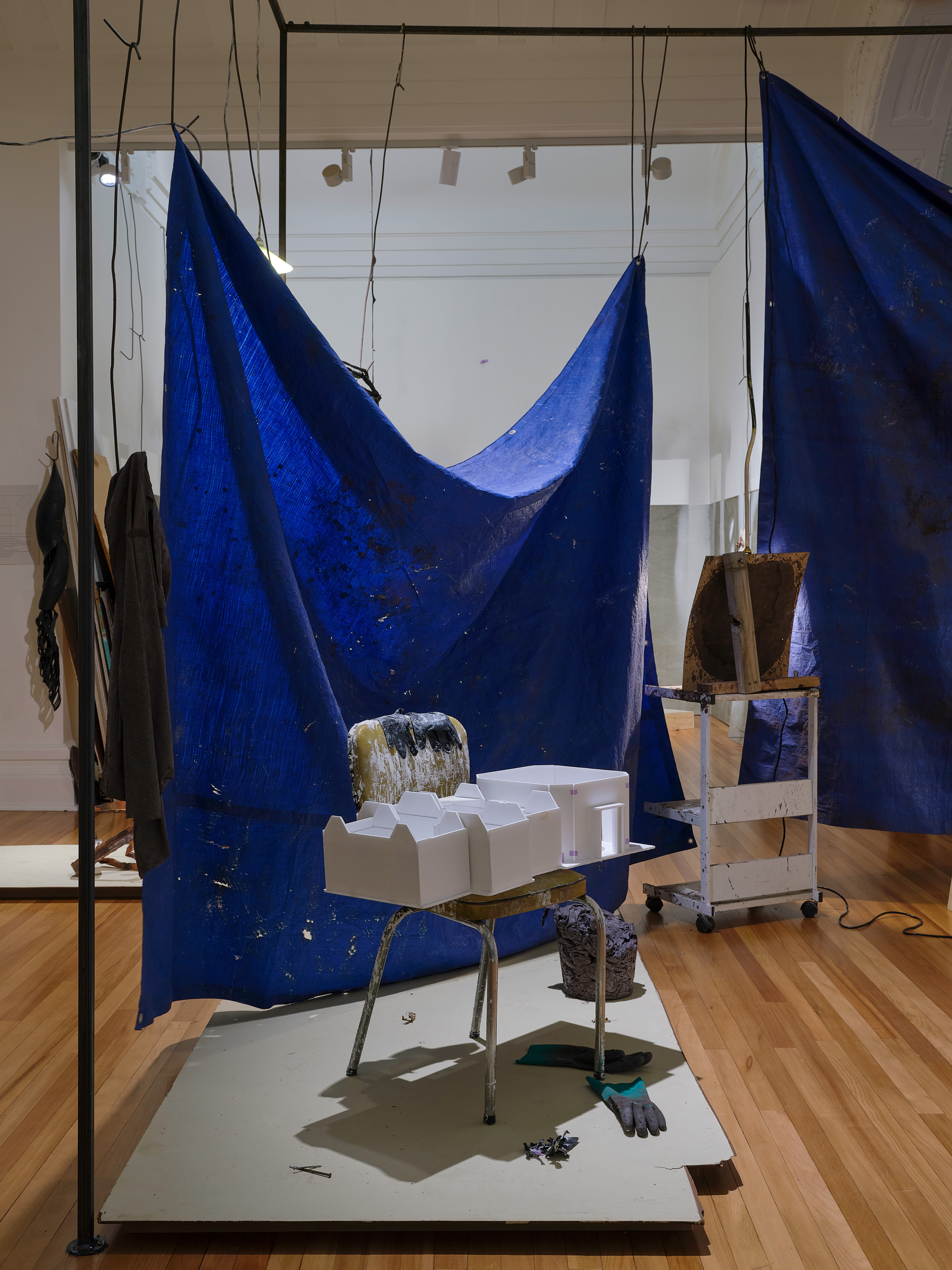
The effect of her work is that it often looks unfinished: it brings the sense of messy possibility and pragmatic making inherent to a studio practice into a gallery space. For The Performance, she initially wanted the curtain to hang lower. The fabric was literally hung in the space: 1.2-metre-wide strips of fabric that she draped over the frame from a genie. The wave in the curtain comes from pieces of wire that were removed after the concrete had hardened. Helpers were outside, soaking the fabric and transporting it in buckets. When the second one arrived, it was too short, which meant she ended up cutting all the other pieces to match. “At first, I hated it,” she says. “And then I realised that’s what’s so good – because it’s awkward and it’s not perfect, which stops it being completely beautiful. It’s a little bit unsettling.”
The Sarjeant show is the closing of a chapter that has seen the artist based in the region for a number of years: she has a studio in Whanganui, and last year was the Tylee Cottage artist in residence, a programme which is supported by Creative New Zealand. Loudon is native to the broader Whanganui area. Her mother Felicity Wallace is an architect, and the family moved to nearby Marton when she was 10. She moved to Te Whanganui-a-Tara Wellington to study at Massey University, graduating in 2016. In 2022, after completing a major show at City Gallery Wellington Te Whare Toi, along with site-specific installations at The Dowse Art Museum and in Tāmaki Makaurau, she contracted a particularly nasty bout of glandular fever, which progressed to ongoing fatigue, which left her debilitated and unable to work. She returned home to Marton to recuperate.
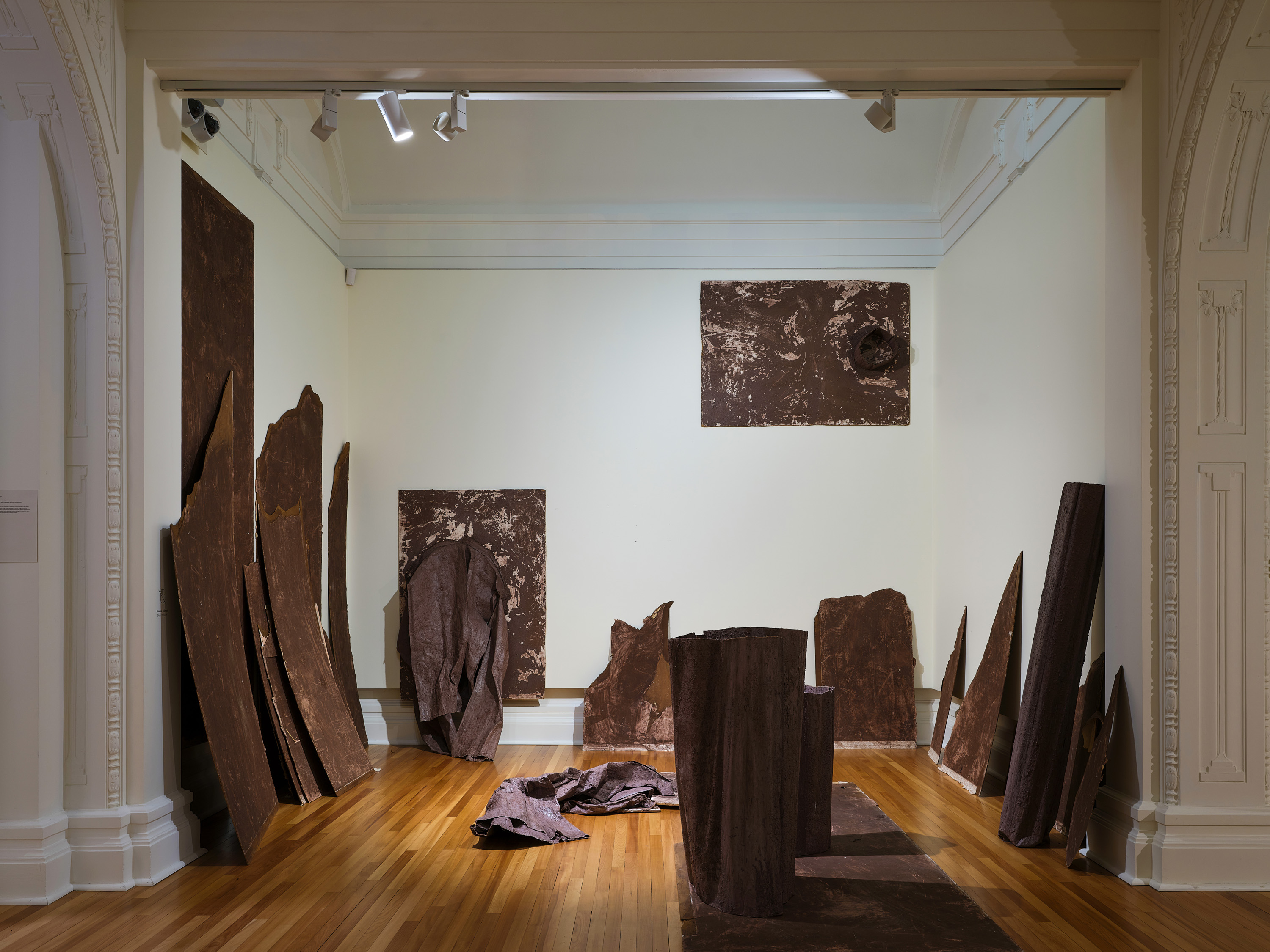
Eventually, she took over a building in the middle of town. Owned by her parents and slated for redevelopment, it had shopfronts downstairs and small flats upstairs. For the next year or so, she experimented on the building, treating it as a giant studio. Over that time, she slowly got stronger – at first, she was only able to work for bouts of 20 minutes or so. She also started playing with different materials, including fabric and metal, along with her more familiar rope and rubber, attaching them to the building itself. In December 2023, supported by the Sarjeant, she opened the space for a weekend, presenting an extraordinary building-sized intervention that felt creepily domestic. Most strikingly, she filled one room – painted red and called The Red Room – with concrete drums covered in fabric attached to the ceiling.
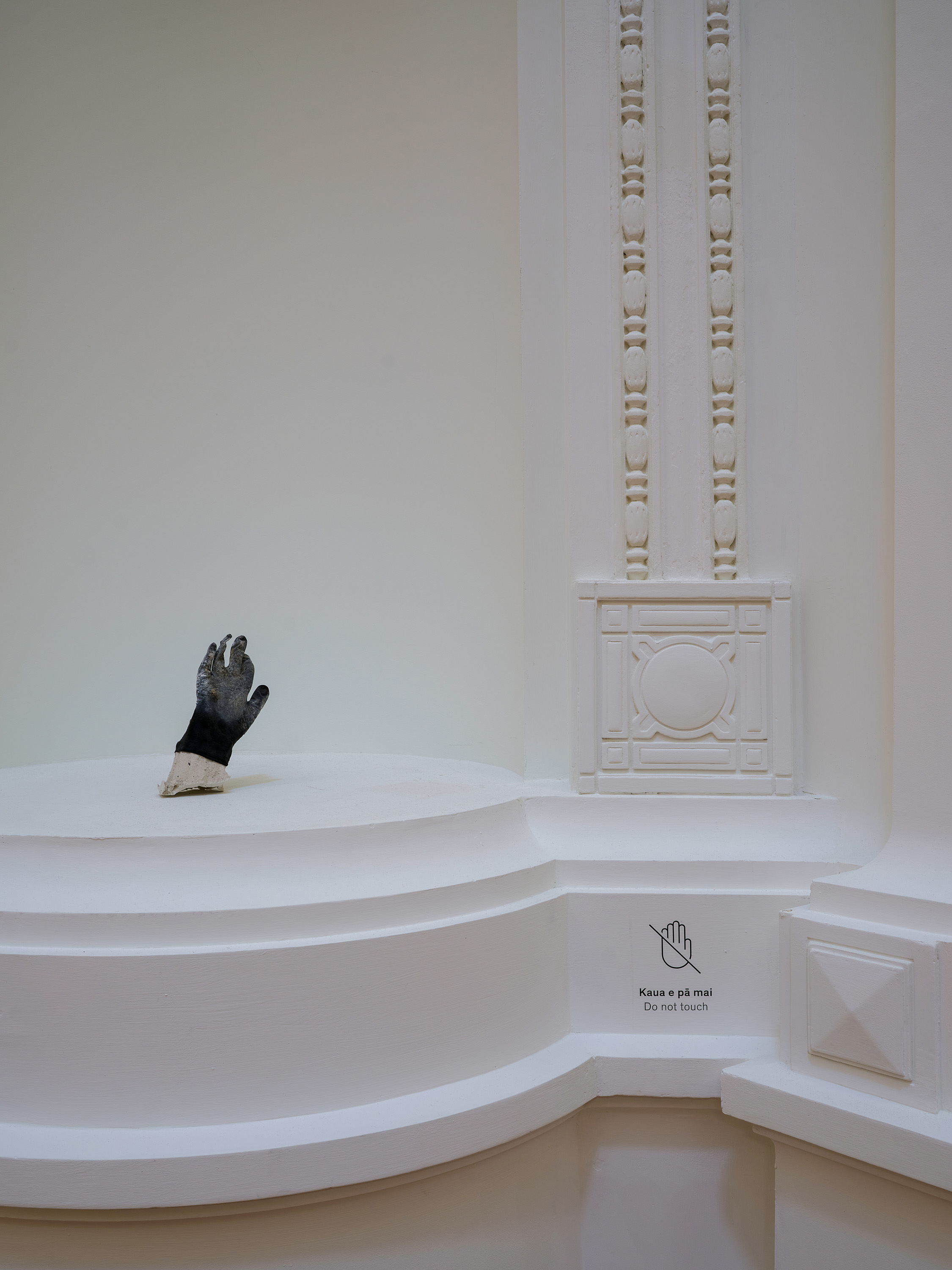
That work, since renamed The Red Room Cut Up, was removed when the building finally came down. The cylinders broke, so she cut them down – she says this in quite a matter-of-fact, even off-handed way. Now two sit on the floor of the Sarjeant. Behind it, hardboard panels from the room are stacked against the gallery’s crisp white walls. Elsewhere, it gets even more provisional: a white plastic chair here, tarpaulins there, drawings, a work inspired by the spraypaint patterns of her studio in a former car-painting workshop. Elsewhere, she has hung old workshirts and jumpers, as if she’s just popped out.
In a couple of months, Loudon will move back to Wellington: she still suffers from fatigue, and is careful with her energy and her routine. New shows beckon: along with site-specific installations, she’s looking to do more object-based work on a smaller scale, and maybe in new materials. As she notes, concrete is brutal to work with. Earlier this year, she made her first work in bronze.
Come October, the show at Sarjeant Gallery will come down. As it does, bits of it will likely break. That’s okay by Loudon – it’s built into the very title of the show, which is a line from a poem in Anne Carson’s book Decreation. “It’s the potential for something to happen, but it might or might not – a potential for a kind of chaos to erupt, but it might not. I feel like it’s really fitting at the moment, where there’s so much tension, as if things might just spill over, but you don’t know if they will.” She pauses. “The show’s the same. Is it finished? Is it still being made? There is this potential to break, but it’s the potential for something – it’s an energy.”
Everything Might Spill
Te Whare o Rehua Sarjeant Gallery until October 4
Related Stories: